Lately I’ve been getting two questions a lot:
- Why did you switch to physics?
- Where will you go with physics? What will you do for work?
Here I’ll try to answer the second question. My shortest and most honest answer — I don’t know! At this point I’m only vaguely sketching out possible career and academic paths, and I just can’t give a definitive answer. But as they say, bear with me! I get why this kind of uncertainty scares people off — university is generally seen as the place after which a person should be able to earn their bread. With a physics degree, things aren’t as clear-cut as with an engineering one. The typical physics bachelor’s grad probably won’t be able to immediately land a job in their field. Meanwhile Computer Science and Engineering majors have a much easier time finding work. So then why, knowing this, do some people still go into physics?
A lot of physicists answer this by saying they just like it. Not only is the answer dubious, it also doesn’t address the main question: “How are you going to make a living?” So for myself I’ve come up with a slightly different answer.
My answer
Yes, I like physics. I like solving hard problems that require imagination and unconventional approaches. I’m struck by how vast and complex this science is, and I’m in awe of the people who built it all in the first place. But there’s another important aspect. Everything is known by comparison, so let’s compare a “career” in computer science and in physics. Personally, the first one feels to me like a walk down a well-worn path, where you almost always see where you’re going and what you’re aiming at. If you picture a 2D plane, it’s comparable to descending along the steepest negative gradient (). At the end of the road you end up in a local minimum, which is comparable to a decent salary at Amazon/Google (a bit exaggerated, but you get the idea). Now look at the physicist’s path. I see it as a long climb up a mountain. With no idea what the final outcome will be, a person climbs the hill. Having made it up, another hill may open up, and it turns out the road leads nowhere. Maybe you’ll get lucky and another local minimum will show up. Who knows, maybe a global minimum will be found — “success”, so to speak.
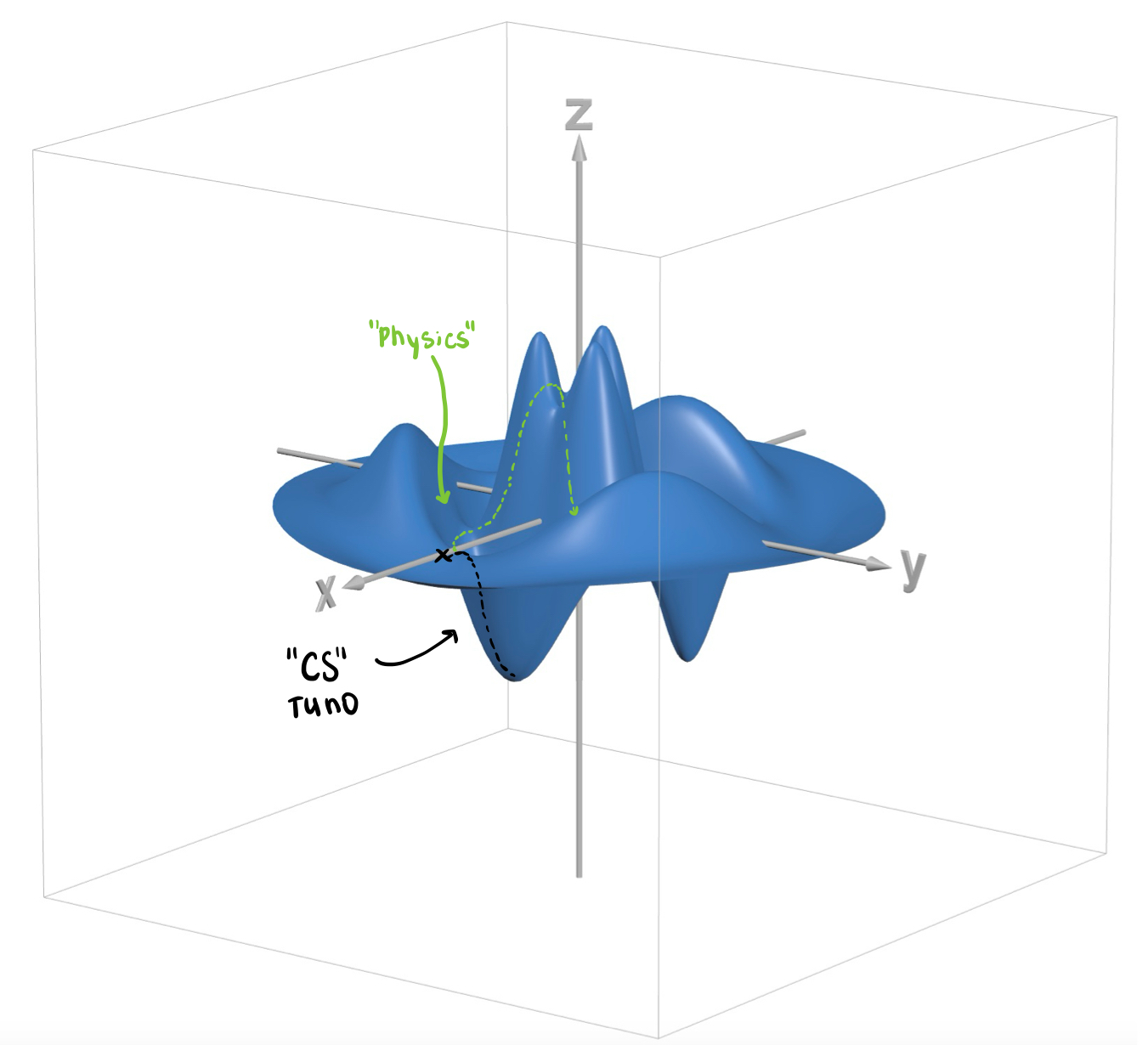
For myself, the choice of physics ties back to the two reasons above. 1) Right now, I just enjoy studying it. 2) Right now, I like the lifestyle where I study/work most of the day for months on end with short intense breaks in between (like during olympiads). During this time I want to see how high I can climb, and what new horizons open up. Maybe I’ll find something valuable, or it may turn out it bears no fruit. It’s a risk and an uncertainty, but precisely those factors should motivate me to work harder. After all, at this stage of life the stakes are much higher.
- Okay, I should mention one more nuance. Usually, physicists can “bail” at the right moment and go work (or rather, rake in cash) in finance/the stock market.
- Also, I wasn’t trying to offend the CS crowd in any way. Personally, this is just how I see things.